
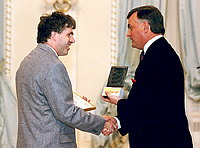
Tuesday, May 4, 1993. The Edmonton Journal is the winner of the 1992 Michener Award. The presentation of the award was made at a dinner hosted by Governor General Ramon Hnatyshyn at Government House in Ottawa.
The Edmonton Journal won the award for a series of stories called 'Psychiatry on Trial' which examined a contentious area of courtroom evidence - the judicial system's reliance on psychiatric testimony. Reporter Tom Barrett had concluded that "serious flaws" exist in that reliance and cited examples of psychiatric gullibility, sharp differences in professional psychiatric conclusions, and overly-willing judicial tendencies to rely on such evidence on fundamental issues of innocence or guilt.
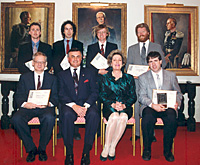
Mr. Barrett accepted the award on behalf of the Journal which was among 50 entries vying for the Michener Award. The Winnipeg Free Press was honoured as runner-up and two other dailies were given Michener Citations of Merit (see below).
Governor General Hnatyshyn praised the quality of this year's entries. He said that truth and accountability were products of the journalistic profession and craft and represented the "very foundation stones of a free and democratic society". He also paid tribute to Bill MacPherson, former publisher of the Ottawa Citizen, who championed the establishment of the annual Michener Award by convincing Roland Michener to lend his name to the recognition of excellence in public service journalism. (Governor General's full text)
1993 Michener-Deacon Fellowship:
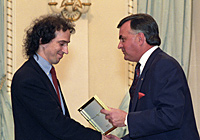
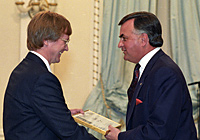
Each year, one or two fellowships have been awarded to mature journalists who wish to use four-month study-leaves to enhance their ability to pursue public service journalism. During the award ceremony, His Excellency Ramon Hnatyshyn presented 1993 Michener Fellowships to David Evans, a reporter on the staff of the Ottawa Citizen and Christian Rioux, a reporter with L'Actualité magazine. (update: Evans fellowship report)
Clark Davey, President of the Michener Awards Foundation, said that "just doing the job (reporting) isn't enough to win you a Michener. We need proof that your work has had the kind of impact that moves people's hearts and their minds - that stirs their sense of justice and changes the rules, and the laws, to make our society a better place. That's what we term 'meritorious and disinterested public service in the field of journalism' and that's the standard against which we measure the dozens of applications our judges consider each year". (the complete text)
Honourable Mention:
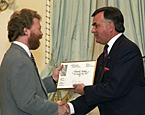
The Winnipeg Free Press, for a story about recent abuse-related children's deaths in Manitoba that were not investigated and the changes that resulted from the Free Press examination. A number of cases involved native youngsters. As the stories were published, criminal charges were laid in three of the deaths, a special review committee was established and the province promised better police work and better training for police and other professional involved in child-abuse cases. This is the third straight year that the Free Press is a finalist and the reporter on the child abuse story, Ruth Teichroeb was the recipient of last year's Michener Fellowship. Editor-in-chief Duncan McMonagle accepted the Citation from the Governor General on behalf of the Free Press.
Citations of merit were awarded to:
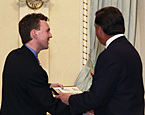
The Toronto Star, for a series on problems in the Ontario air ambulance service and changes caused by the Star's news stories. The service became the target of reporter Kevin Donovan after a tearful phone call from someone who said Ontario's air ambulance service was an accident waiting to happen. It sent him on a four-month investigation among tight-lipped provincial, government, and private sector sources. The stories disclosed that the $33 million-a-year air ambulance service was plagued by medical and aviation problems that jeopardize the lives of some of the 16,000 patients who fly with it each year. As a result of the stories, there has been one inquest established for a death, a senior official fired for conflict of interest and the launch of an internal government inquiry. Mr. Donovan accepted the Citation from Governor General Hnatyshyn on behalf of the newspaper.
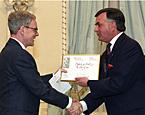
The Globe and Mail, for the Red Cross tainted blood controversy. Reporters Rod Mickleburgh and André Picard were asked to find out how and why the safety system failed for 1,000 Canadians who died from HIV-infected blood inflicted by operations and transfusions. From the murky record, often dimly recalled for assorted reasons, there continues to emerge evidence that demands an official reckoning from the federal government, Red Cross, and other private and public organizations responsible for lethal "tainted blood". Representing the Globe and Mail, editor-in-chief William Thorsell accepted the Citation from His Excellency.
Judges for the 1992 Michener Award:
Arch MacKenzie, Chair of the judging panel; former Ottawa bureau chief of the Canadian Press and the Toronto Star; Jeannine Locke, former journalist with the Saskatoon Star-Phoenix, the Ottawa Citizen and the Toronto Star; now-retired CBC film-maker; Marilyn MacDonald, former Atlantic provinces magazine and CBC journalist, now director of public relations at Dalhousie University, Halifax; Barry Mullin former ombudsman, Winnipeg Free Press, now journalism lecturer at the University of Winnipeg; Claudette Tougas, editorial writer, La Presse, Montreal.
Judges for 1993 Fellowship
Senator Keith Davey, chair of the judging panel; Sandy Baird, former publisher of the Kitchener-Waterloo Record; Emmanuelle Gattuso, ex-senior vice-president of the Canadian Association of Broadcasters; Huguette Laprise, deputy chief, the French-language arm of The Canadian Press, Montreal; and Guy Rondeau, retired chief of the Quebec Service of La Presse Canadienne, Montreal.
The Michener Award is the only Canadian journalism award bearing the name of a Governor General and it is won by the news organization rather than individual journalists. It is open to broadcast and print organizations, large and small.