

Sunday, December 2, 2007
By Chris Cobb
The Canucks, the landmines and the bombshell; In 1997, world leaders gathered in Ottawa to sign an agreement now ridding the world of landmines. On the eve of 10th-anniversary celebrations of that treaty, Chris Cobb asked key players to take readers behind the scenes during the 14 frenetic months that Canada led the way to a deal. This is the untold story.
In a series of frenzied phone calls and meetings, Lloyd Axworthy's aides began a rescue effort.
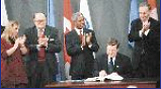
There were smiles, handshakes and backslapping on the day Foreign Minister Lloyd Axworthy signed a treaty committing Canada to halt the human carnage caused by antipersonnel landmines.
It was, everyone agreed, one of the proudest diplomatic moments in the history of Canadian foreign policy.
Ten years on, the treaty - "a success in progress" - has undoubtedly saved thousands of lives and improved life for countless landmine survivors. At the time the treaty was signed, 130 states had stockpiled an estimated 260 million antipersonnel mines. Today, some 46 countries, mostly those not part of the treaty, have an estimated 176 million. Millions remain hidden in the ground.
When Axworthy put pen to paper -- the first of 121 countries to do so that day -- it marked the end of a diplomatic game of high-stakes poker that played out over 14 frenetic months in capital cities across the globe.
Tomorrow, many of the key players who pressed to achieve the landmine treaty will be in Ottawa to celebrate its 10th anniversary. The making of that treaty is a remarkable story of dogged determination and hardball politics at the highest levels. Until now, few who forged the unprecedented alliance between the world's middle powers have spoken about what went on behind the scenes. This fall, in conversations in Ottawa, the United States, Africa, Norway and Jordan, I spoke to key players to find out how the deal got done.
At that Dec. 3, 1997, ceremony at the Ottawa Conference Centre, Axworthy and his boss, Prime Minister Jean Chrétien, shared the stage with Jody Williams, the often abrasive, always plain-spoken public voice of the International Campaign to Ban Landmines, and also with United Nations Secretary General Kofi Annan and Cornelio Sommaruga, a wily Swiss diplomat who was then head of the International Committee of the Red Cross. Weeks earlier, Williams and ICBL had been named joint recipients of the 1997 Nobel Peace Prize for their efforts in securing the yet-to-be-signed treaty.
Seized by the festive nature of the occasion, Chrétien had wanted the entire Liberal caucus to cheer Axworthy as he signed the treaty, but the room was crammed with more than 2,000 international diplomats, aid workers and observers. Many had arrived from Africa unprepared for the cold and had to be outfitted with coats and mitts by local charity shops.
Missing from the ceremony was Diana, Princess of Wales, a potent champion of the campaign who in a short but deliberate effort put landmines on front pages across the world. The official invitation from the government of Canada was on her office desk the day she died, Aug. 31.
At the outset of treaty negotiations, diplomatic niceties were tossed. Hundreds of non-governmental organizations (NGOs) -- dozens of UN aid agencies, plus others under the umbrella of the International Campaign to Ban Landmines alliance -- were invited to join diplomats and international officials in Ottawa in October 1996.
The official name of the conference was Towards a Global Ban on Anti-Personnel Landmines: An International Strategy Conference. It is now known as The Ottawa Process.
During that three-day meeting, a strategy was cobbled together at lightning speed with unprecedented gall. Never before had NGOs had such input, to the irritation of diplomats.
During the negotiations, Canadian diplomats, schemed with the ICBL and the Red Cross, lied to U.S. diplomats to keep their plan secret. At the time, the Americans considered the initiative harmless hot air. This would change. Months later at final-stage meetings in Brussels and Oslo, the U.S. would launch a full-scale, bare-knuckle diplomatic assault to derail the treaty.
In 1993, six non-governmental organizations joined forces to create the International Campaign to Ban Landmines. Moved initially by the carnage of landmines in Cambodia, they united in frustration over superpower stonewalling.
The ICBL launched an international campaign led by the Vietnam Veterans of America. Their efforts were helped in no small part by an emerging communications technology called e-mail. The Internet allowed the ICBL to exist as a virtual organization, which proved key to the anti-land mine campaign. By the time the treaty was signed, more than 1,000 NGOs had joined.
British veteran Rae McGrath, founder of the Mines Advisory Group, credits individuals with getting the job done. No matter their affiliation, he says, they were "motivated to the point of stupidity and bullies enough to keep the process on track."
Cornelio Sommaruga, the son of a nurse, was instrumental. "Travelling around the world, I had been tremendously impressed by the work nurses were doing in surgical hospitals, helping landmine victims," he told me during an interview at a conference on landmines in Jordan two weeks ago. "They were telling me, 'Please help stop this horrible carnage. It isn't enough just to talk about it.' "
The issue consumed Sommaruga, but he knew without legal clout the campaign would fizzle.
In late 1993, he invited doctors, lawyers, mine manufacturers and others with vested interests to a symposium in Montreux, Switzerland. When only a vague resolution emerged, Sommaruga wrote his own statement calling for a ban. Without consulting his board or ICRC lawyers, he released it to the media. It was a radical departure for the steadfastly neutral ICRC.
As chief ambassador of the Red Cross, Sommaruga met often with world leaders. As it turned out, his first appointment after his controversial statement was in April 1994 with the newly elected Jean Chrétien. The Canadian prime minister was preparing for his first G7 meeting in Naples, as Sommaruga was well aware. Given that landmines were the biggest threat to Canadian peacekeepers, Sommaruga calculated the notion of a ban might be received favourably.
But Chrétien deflected the Red Cross chief to Foreign Affairs Minister André Ouellet who brought a large group of hastily convened advisers to meet with Sommaruga later that afternoon. The Department of National Defence was not going to relinquish its right to use landmines without a fight.
Ouellet told Sommaruga to draft a proposal for consideration. The Red Cross president returned to Geneva to write. Once done, he decided to spread his net and also delivered the draft to Geneva-based diplomats from the U.S., Italy, Japan, France, Germany and Britain. The strategy worked: The meeting in Naples produced relatively tough wording in support of a landmine ban. The statement was not really designed to achieve anything, but four years later it proved an invaluable reminder to countries that were reluctant to sign the treaty for fear of alienating the U.S.
Former solder-turned-diplomat Bob Lawson was part of a tightly knit pro-ban unit within Foreign Affairs formed by senior bureaucrat Jill Sinclair. The two had met in 1978 in air cadets.
Lawson, one of dozens of former soldiers prominent in the international anti-landmines movement, had left the armoured tank division as a captain in 1992 to study international affairs. In February 1995, he ran federally for the NDP in a federal byelection in Ottawa-Vanier and that same year, he was voted social activist of the year by Ottawa XPress.
It was during the election campaign that Sinclair first called with a job offer.
"I agreed after the third call," he says. "I thought, 'Is there any reason why we can't ban landmines?' "
Sinclair, an unusually progressive risk-taker in the cautious bureaucracy that is Foreign Affairs, had also hired Mark Gwozdecky, a young diplomat with whom she had worked in Damascus. The three formed a core who reported through Sinclair to director-general Ralph Lysyshyn.
Although the anti-landmine movement was growing internationally, it wasn't until a casual remark by Ouellet that Canada's role on the issue came into focus. "They should be banned not only in Canada but everywhere in the world," Ouellet told a reporter in Quebec in response to a question. The department's small pro-ban faction considered the comment a ministerial green light.
Months later, in a January 1996 cabinet shuffle, Ouellet was out and Axworthy was in. To begin his tenure, the new minister canvassed senior bureaucrats for policy suggestions. Get behind the movement to ban landmines, he was advised.
Elsewhere in Europe and North America, the movement was gathering momentum. The Norwegian parliament announced it would pursue a ban. Meanwhile, the Red Cross and the ICBL were at work on highly effective public relations campaigns.
In the spring of 1996, Canada grabbed the initiative. When a UN review process on the issue failed, Bob Lawson called a news conference in Geneva and invited interested countries and NGOs to Canada for a landmine conference that October.
Several diplomats approached to ask about the plan. Problem was, there wasn't one. "We were making it up as we went along," Lawson recalls. "The only detail we had was, 'Let's do a conference this fall.'"
The challenge was to attract major states. "We also had to make it clear we were going to change the rules of the game by welcoming NGOs. We spent a lot of time in Washington trying to get them on board. People were uncomfortable having NGOs at the table."
Before proclaiming itself a leader of nations, Canada had to take care of some internal housekeeping. Foreign Affairs and DND were bickering.
Ralph Lysyshyn of Foreign Affairs was called to the Privy Council Office -- the powerful secretariat responsible for coordinating federal cabinet business -- for a peace-making session with DND officials. James Bartleman, one of the prime minister's closest aides, chaired the meeting.
As Defence officials were making the case for landmines, an officer whispered into Lysyshyn's ear:
"Ask when they last used them."
So he did. "When did our military last use landmines?" The reply? "During the Korean War."
Turning to Lysyshyn, Bartleman said: "I think you just won the argument."
More than 50 countries participated in the Ottawa conference in October 1996, and 24 others attended as observers along with dozens of NGOs.
On the streets outside the Conference Centre, DND created a festive air with de-mining exhibits. But inside, things weren't going well.
Lysyshyn, chairman of the conference, observed sharp diplomats from anti-ban countries seizing control and feared they'd derail the issue.
In a series of frenzied phone calls and meetings, Axworthy's closest aides began a rescue effort. Lysyshyn phoned his boss, assistant deputy minister Paul Heinbecker.
"The conference has momentum," he advised. "We can still make something of it."
He warned if the Ottawa conference failed, Belgium was waiting to pick up the pieces. Failure would be a blow to Canadian pride and reflect badly on the senior diplomats and the minister whose reputations were on the line.
It was Lysyshyn's idea to present delegates with a challenge: Return to Ottawa in one year's time to sign a treaty. The outrageous proposition would demand months of fast-track negotiations and $2 million in diplomatic travel and expenses.
"Are you sure you can do it?" Heinbecker asked. Four hours later he called Lysyshyn back. "You've got your $2 million. Go for it."
Meanwhile, Sommaruga had broken away from the conference. He was having lunch at the Ottawa office of the Canadian Red Cross when his meal was interrupted by a phone call.
It was Lloyd Axworthy. "Could you come and see me?" he asked. "I need your help."
When Sommaruga arrived, the foreign minister was waiting with Jill Sinclair and Jody Williams. Axworthy was holding the final conference communiqué -- a bland compromise that effectively rendered the conference a waste of time.
"Axworthy was very disappointed," recalls Sommaruga.
During their meeting, Sommaruga suggested Axworthy address delegates not as the head of the conference but as the foreign minister of Canada -- a technicality that gave Axworthy the freedom he needed.
On the Friday night, the minister's aides, helped by Jody Williams and her future husband Steve Goose of the NGO Human Rights Watch, secretly drafted Axworthy's speech at the Lester B. Pearson building.
"Axworthy had two choices," says Bob Lawson. "He could either deliver a thank-you-for-coming-and-have-a-nice-day speech or a bombshell speech."
They decided the bombshell should drop as a fait accompli.
"We didn't want a government delegate getting up and saying 'I don't think this is a good idea, I have to consult with my government. It would have blunted the momentum."
Fearing isolation, the street politician in Axworthy was cautious: "Who's with us?" he asked. The Norwegians and Austrians were onside, but the Belgians were angry at Canada for stealing the conference limelight. The Americans, Brits and French were sure to be mad as hell.
Axworthy gave the go-ahead.
While the speech was being drafted, a member of the U.S. delegation approached Lysyshyn for advice.
"Is anything happening that I shouldn't take my early plane tomorrow?" he asked. "No," Lysyshyn lied.
The Canadians and their ICBL partners got a boost when they were approached by Mary Fowler, a member of the UN delegation and wife of Bob Fowler, Canada's ambassador to the UN.
"I know what you're up to and we've talked to the secretary general," she said as she handed him a note from Kofi Annan. "He supports what you're doing."
On the Saturday, Axworthy arrived at the Conference Centre to deliver the speech.
"We were taking a high risk," Lysyshyn recalls.
The ploy worked perfectly.
"I am convinced we cannot wait for a universal treaty," Axworthy told delegates. "I am convinced we can start now, even though we may have to proceed with a treaty that does not, in the first instance, include all the states of the world. Such a treaty can be a powerful force that establishes the moral norm -- that the production, use, stockpiling and transfer of anti-personnel mines is to be banned forever.
"And so today, I commit Canada to this goal, to work with our global partners to prepare a treaty that can be signed by December 1997 and implemented by the year 2000. I invite and challenge all of you to join us to attain that goal."
Williams and Sommaruga rushed to the microphones to express their support, but could barely make themselves heard above the cheers from the NGO side of the room. Axworthy closed the meeting.
On the other side of the room, diplomats sat stunned.
The penultimate scene in this diplomatic saga features angry protesters parading in the streets of Oslo, berating Canada for losing its nerve and sacrificing its principles.
It was September 1997. For three weeks, 89 countries had been working in the Norwegian capital to seal the treaty to ban anti-personnel landmines.
In the months leading to the final talks, Austrian bureaucrats had produced a draft text, which led to the June 1997 Brussels Declaration, which set out treaty principles.
Countries had to accept those principles to be invited to the Oslo negotiations that began Sept. 1, the day after Princess Di was killed. The final negotiations were chaired by Jack Selebi, a tough-minded black South African who was well aware Americans were turning the screws on every delegation over which they had influence. Which is to say, most of them.
The U.S. had earlier threatened to remove U.S. defences from Norway if Norwegians supported the treaty. Gambling that U.S. defences were for American convenience, Norway called the bluff.
President Bill Clinton, pressured by military advisers, dispatched a huge delegation to Oslo to cajole, threaten and gently persuade delegations to break the formidable anti-landmine alliance that had formed during 14 months of frenetic global negotiations.
The U.S. wanted in on the treaty but only on its own terms. It wanted exemptions, but exemptions weren't part of the deal.
In Oslo, the U.S. called meetings with every NATO country.
"They brought in a dozen four-star generals," recalls Bob Lawson. "There were generals wall to wall twisting arms."
Lysyshyn was also in Oslo, largely in the background, communicating with Axworthy and Chrétien in Ottawa.
Clinton, who told the United Nations early in his presidency that he wanted a mine ban, had discussed the treaty with Chrétien during a golf game that summer. As the Oslo talks reached a conclusion, the president and the prime minister talked again.
"The Americans were heavy-handed and annoyed a lot of people," recalls Lysyshyn, "but the prime minister had got quite keen on the treaty and was phoning around. He called Clinton and said,'This is really too bad the U.S. is not in this in some way. Can't you make another effort?'"
Clinton assumed they were out of time. But Chrétien made a phone call to Lysyshyn, who advised that treaty rules allowed for a 24-hour delay. The U.S. president promised to try to find a compromise.
Canada pushed for the delay.
"The Americans went off and the world thought we were talking to them," says Lysyshyn, "but we weren't. The Americans were talking among themselves."
Lysyshyn, now Canada's ambassador to Russia, had phoned Steve Goose of Human Rights Watch prior to requesting the delay. Goose put his hand over the mouthpiece to tell Jody Williams, "The Canadians are caving."
Furious and emotionally exhausted, Williams grabbed the phone, screamed insults and hung up. Then she rallied her pro-ban troops. Within hours they were on the streets with banners -- "When Did Canada Become the 51st State?" -- chanting anti-Canadian and anti-American slogans.
Axworthy and Chrétien, both convinced the treaty would have more credibility if the Americans signed, were working the phones. Sandy Berger, Clinton's national security adviser, called Axworthy and said they had a deal.
"Break out a good bottle of Scotch," Axworthy said in a phone call to his wife. "I'm coming home."
But then Berger called back. The Pentagon wasn't happy. No deal.
Ten years later, Williams is still convinced the official Canadian version of events is an effort to rewrite the real truth. "They were dangerously close to caving," she says.
The Canadian delegation was embarrassed and horrified, she says.
"They'd worked their asses off for the treaty and were about to be sold out. They were as pro-ban as we were and they were taking the brunt of us insulting Canada. They were embarrassed, and so they should have been. It was appalling. But our pressure bore fruit."
Bob Lawson had to walk through protesters as he left the Canadian embassy. "What the hell is Canada doing?" the crowd shouted. "No backroom deals."
"We were looking at our shoes," Lawson recalls. "I remember speaking to one African delegate and asking what his instructions from his government were. He was told, 'Just follow Canada.'"
The U.S. delegation withdrew the next day. "We wish the treaty well," they said in essence, "but we can't sign."
At the same time, Sommaruga of the Red Cross was tiring of efforts to soften his support of the treaty. He cut short a delegation of ambassadors. "I will tell the victims that if we do not conclude the Ottawa Process and stop this suffering it is because of you," he warned.
Next he called to find out why Canada had asked for the delay. Axworthy assured him, "It will all come good."
But the delay may have been costly to Axworthy. Vermont Senator Patrick Leahy, a vigorous pro-ban supporter, had nominated Axworthy for the Nobel Peace Prize that would go to Williams and the ICBL.
Axworthy, now president of the University of Winnipeg, figures the delay and the street protests kept his name off the prize. "It would have been great," he says, "but we did the right thing."
During the signing ceremony on Dec. 3, 1997, shortly before the celebrations, Chrétien leaned over to Sommaruga and harkened back to their first meeting in 1994. "Just think," he whispered, "we started this together."
(Chris Cobb was awarded the 2007 Michener-Deacon Fellowship to research and write about landmines.)
LANDMINES IN NUMBERS
Number of landmines estimated to be buried in at least 78 countries: 80 million to 100 million
Known landmine casualties (killed and maimed) in 2006: 5,751
Deaths: 1,367
Civilians killed or maimed: 4,313
Children killed or maimed: 1,955
Highest casualty rates:
Cambodia, Afghanistan, Colombia
Known maimed landmine survivors worldwide(actual number unknown): 473,000
Types of anti-personnel landmines: 300+
Cost to produce one mine: $3
Cost to remove one mine: $300+
Number of countries that have signed the International Landmines Treaty: 155
Estimated number of anti-personnel landmines stockpiled by 131 signatory states before 1997 Ottawa Mine Ban Treaty: 260 million
Estimated stockpiled in 2006: 176 million
Estimated stockpiles in major non-signatory countries:
China: 110 million
Russia: 26.5 million
United States: 10.4 million.
Number of anti-personnel landmines destroyed in 2006: 2.3 million.
Largest dollar contributor to international de-mining: United States
Countries still known to be using landmines: Russia (in Chechnya) and Burma (Myanmar)
Non-state groups (rebels) planting landmines: 13
Estimated number produced each year and sold legally and illegally: 10 million
Origin of mines found in Angola: Belgium, China, former Czechoslovakia, Italy, South Africa, United States, former Soviet Union, Germany
Estimated percentage of land unusable in Afghanistan and Cambodia because of mines: 30
Estimated total funding for landmine clearing/victim assistance in 2006: $475 million
Largest contributor: United States ($94.5 million)
Amount U.S. military requested in 2006 to develop 'self-destructing' smart landmines: $1.66 billion
Contribution of Canada, which ranked fourth on donor list in 2006: $28.9 million
Canada's top recipient: Afghanistan
Top 10 recipient countries (in order): Afghanistan, Lebanon, Angola, Iraq, Cambodia, Sudan, Bosnia and Herzegovina, Laos, Vietnam, Ethiopia
Sources: Landmine Monitor Report, 2007; International Campaign to Ban Landmines; International Physicians for the Prevention of Nuclear War
(REPRINTED BY PERMISSION)